Ticket price
Dates
Location
Approximate timings
The performance lasts approximately 5 hours and 30 minutes, including two intervals.
Act I:
1 hour 50 minutes
Interval:
40 minutes
Act II:
1 hour 10 minutes
Interval:
30 minutes
Act III:
1 hour 20 minutes
Expand all dates
Sunday 11 October, 3.00pm
Wednesday 14 October, 5.00pm
Saturday 17 October, 3.00pm
Guidance
This production contains nudity, blood, violence and self-harm. There are pyrotechnics used in Act II. Please note that, as this is a new production, age guidance and content warnings may be subject to change.
Language
Sung in German with English surtitles, which are displayed on screens above the stage and around the auditorium.
Generous support from
Exceptional philanthropic support from
Mr Stefan Sten Olsson and Mr John Tierney and Royal Ballet and Opera Principal The Julia Rausing Trust
Generous philanthropic support from
Philipp Freise, Athena P S Ko, John McGinn and Cary Davis, The Thompson Family Charitable Trust, the Parsifal Production Syndicate, The Wagner Circle and Royal Ballet and Opera Patrons
Synopsis
The story of Parsifal
Amfortas, King of the knights of the Grail, suffers from a wound that will not heal. The Grail community guards two sacred relics: the Holy Grail (Christ’s cup from the Last Supper), and the spear that pierced his side on the cross. Klingsor once sought admission to the Grail brotherhood. Unable to achieve the required chastity, he castrated himself but was still denied admission. He became their enemy, creating an enchanted realm to lure the knights from their vows. Amfortas set out to defeat Klingsor but was seduced by Kundry, allowing Klingsor to seize the sacred spear and wound him. Only the same spear can heal the wound. A prophecy promises Amfortas salvation through a ‘pure fool, made wise through compassion’.
ACT I: THE REALM OF THE GRAIL
As Amfortas is carried to the lake, where bathing eases the pain of his wound, Kundry arrives with a balm for him. Wild and mysterious, she has found refuge in serving the Grail community. Soon a young stranger appears, pursued by Grail Knights for killing a swan in their sacred forest. The elder knight Gurnemanz confronts him with the suffering he has caused. The young man knows almost nothing about himself, not even his name. Kundry tells him that his father, Gamuret, died before his birth and his mother, Herzeleide, raised him alone. When she reveals that Herzeleide died after her son abandoned her, the young man reacts with horror and rage, attacking Kundry until Gurnemanz restrains him.
Suspecting the stranger might be the prophesied ‘pure fool’, Gurnemanz takes him to witness the Grail ceremony. Amfortas’s father Titurel commands him to unveil the Grail, renewing the community’s strength but also prolonging Amfortas’s life and agony. Amfortas resists the ritual, longing for death, but finally submits. The young man watches Amfortas’s suffering with profound distress, yet cannot understand what he has experienced. Disappointed, Gurnemanz drives him away.
ACT II: KLINGSOR’S REALM
Klingsor sees the young stranger approaching and summons Kundry, who is under his power. He orders her to seduce him, as she once seduced Amfortas. Kundry resists, but Klingsor forces her to obey. The young man defeats Klingsor’s knights and enters an enchanted garden, where the Flowermaidens compete for his attention. Kundry calls him by his forgotten name, ‘Parsifal’, awakening childhood memories. She reveals that after Gamuret’s death, Herzeleide raised him far from weapons and war to protect him from his father’s fate. Kundry describes his mother’s devotion and the grief Parsifal’s departure caused her. He, in return, grasps his own part in her suffering. Kundry offers him a kiss, invoking his mother’s love while awakening sexual desire. Suddenly Parsifal understands the suffering he witnessed at the Grail: confronted with the same woman and the same temptation to which Amfortas succumbed, he experiences Amfortas’s agony as his own. Through compassion, the ‘pure fool’ has become wise.
Parsifal rejects Kundry. She reveals that she once laughed at Christ on his way to the cross and has since been condemned to pass through life after life, remembering her past existences. Longing for release, she begs Parsifal to give himself to her, but he understands that yielding would only repeat Amfortas’s fall. Kundry calls for Klingsor, who hurls the sacred spear at Parsifal. Parsifal seizes it, and Klingsor’s realm collapses.
ACT III: THE REALM OF THE GRAIL
Years have passed. The Grail community is in decline: Amfortas refuses to unveil the Grail, since doing so would prolong his suffering. Deprived of its life-giving power, Titurel has died and the knights have lost their strength. Gurnemanz lives as a hermit. On Good Friday he finds Kundry, who has returned once more and asks only to serve.
A stranger approaches with the sacred spear. Gurnemanz recognises Parsifal, finally returned after years of wandering. Learning what has happened, Parsifal grieves that he has returned too late. Kundry washes Parsifal’s feet, and Gurnemanz anoints him King of the Grail. Parsifal baptises Kundry, who sinks lifeless to the ground, finally released from her cycle of successive lives. The knights carry in Titurel’s body and demand that Amfortas unveil the Grail. He refuses, begging them to kill him rather than prolong his agony. Parsifal touches Amfortas’s wound with the sacred spear, bringing his suffering to an end.
Creatives
The artists and creatives behind the production
Composer
Libretto
Director
Set Designer
Costume Designer
Lighting Designer
Movement Director
Video Designer
Dramaturg
Discover
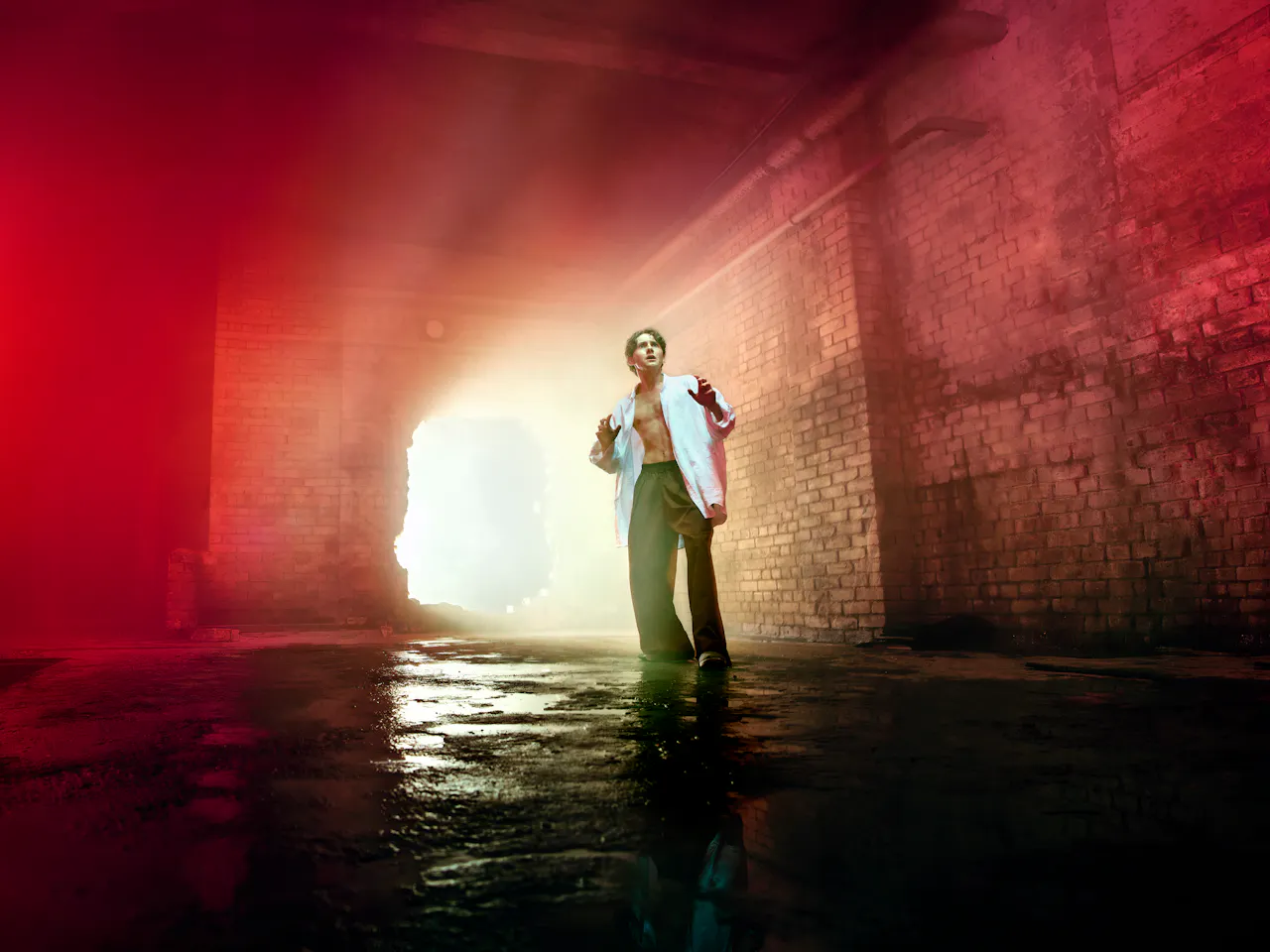
A young man is hailed as the saviour of the crumbling Kingdom of the Grail – but is he all he appears to be? Wagner’s Parsifal is a majestic, shimmering and revelatory musical experience where religious ecstasy meets agony, awe and hope. Breathtaking lighting and a hallucinatory, dystopian set design bring Wagner’s all-consuming final opera to pulsating life in Evgeny Titov’s bold, dreamlike and disturbing debut production for The Royal Opera.
More than an opera
The inspiration
Wagner composed Parsifal between 1877 and 1882, and described it not as an opera, but a ‘Bühnenweihfestspiel’, or ‘festival work to consecrate a stage’. It was first performed in July 1882 at Bayreuth, Wagner’s custom-built theatre, which was initially constructed to house the operas of his Ring cycle. The opera’s source text was Wolfram von Eschenbach’s medieval poem, Parzival, with Wagner’s libretto combining elements of Christian and Buddhist ideology, as well as Arthurian legend. To find out more about the opera, go to our Parsifal Essentials page. For more on Wagner’s eventful life and his other works, go to our Creative Spotlight: Richard Wagner page.
Music on an epic scale
The music
Debussy described Parsifal as ‘One of the most beautiful edifices in sound ever raised to the glory of music.’ The score is radiant and powerful, from the soaring Vorspiel (Prelude), to the ethereal Good Friday Music. As is typical of late Wagner, the music features Leitmotifs, or repeating melodic fragments which are associated with different themes and characters, and which develop and transform as the opera progresses. The opera – Wagner’s third-longest – is epic in scale, with the music creating a timeless, unearthly atmosphere. Even Gurnemanz, one of the knights’ leaders, seems to sense this when he introduces Parsifal to the Grail ritual at the end of Act One, announcing, ‘Here, time turns into space.’
The pure man: the guilty woman
The characters
The ’pure, innocent’ character of Parsifal is contrasted, in the opera, with the character of Kundry, who is defined by her guilt. She is the only principal female role, and she serves the knights of the Grail temple. She is also used by the sinister Klingsor as an agent of seduction. Klingsor describes her as the reincarnation of ‘Herodias’ – the scheming wife of Herod – but in some productions, her journey is often viewed as the tale of a soul travelling towards redemption.
Accessibility and resources
Listen to an Audio Described introduction on SoundCloud.
There is lift access and there are step-free routes to over 100 seats in the Stalls Circle, Balcony and Amphitheatre. Some seats in the Stalls Circle, Balcony, Amphitheatre and the Donald Gordon Grand Tier are accessed by 9 steps or fewer. There are 10 steps or more to access seats in the Orchestra Stalls.
You can use the assistive listening systems in our auditoriums. Surtitles, captions and translations in English are displayed on screens above the stage and around the auditorium.
Join our Access Scheme for priority access to tickets and to inform us of your access requirements.
See our Accessibility page for more information or view a visitors guide (PDF, 12.0 MB).
Be the first to know
Sign up to hear the latest Royal Ballet and Opera news, receive ticket alerts, and discover how to support us.